Ceylon Cinnamon Alba vs C5 vs M5: Which Grade to Buy?
Ceylon Cinnamon Alba vs C5 vs M5: Which Grade Should You Buy?
Written by Ceylon Spice Garden's sourcing and quality team — with direct relationships with certified Sri Lankan cinnamon producers and over a decade of experience grading, importing, and curating authentic Ceylon spices.
Alba is the finest, thinnest-quilled grade — lowest coumarin, most delicate flavor, best for daily health use and premium cooking. C5 is the mid-tier workhorse — excellent quality at a lower price, ideal for everyday cooking and baking. M5 is a budget-grade with thicker quills and stronger, more pungent flavor — suitable for rustic cooking and simmering but not recommended for health supplementation. For health use, always choose Alba or C5 Special.
1. The Sri Lanka Standards Cinnamon Grading System Explained
Ceylon cinnamon (Cinnamomum verum) is graded and certified under the Sri Lanka Standards (SLS) system, which classifies quills (rolled cinnamon sticks) primarily by their diameter and quality of roll. The thinner and more tightly rolled the quill, the higher the grade — and the more labor-intensive the production, which is why premium grades command higher prices.
Understanding this system matters for two reasons. First, coumarin content — the naturally occurring compound that can be harmful in large daily doses — is directly linked to grade. Thinner quills (like Alba) have proportionally less bark per roll, meaning significantly lower coumarin compared to thicker, lower grades. Second, flavor differs meaningfully: higher grades have a more delicate, sweet, complex cinnamon note while lower grades trend towards sharper, more pungent profiles.
This is also what separates authentic Ceylon cinnamon from cassia — as explored in our guide on Ceylon cinnamon vs cassia health benefits. Even the lowest Ceylon grade is far superior to cassia in terms of safety and authenticity.
2. The Full Grade Ladder: From Alba to H2
There are six primary grades of Ceylon cinnamon quills under the SLS classification system. Most consumers only encounter three — Alba, C5, and M5 — but understanding the full ladder helps you appreciate where each sits.
Below the quill grades, there are also quillings (broken pieces), featherings (inner bark shavings), and chips (bark offcuts) — all of which are genuine Ceylon cinnamon but considerably lower in quality and presentation. These are typically sold as budget cinnamon powder or bark chips for brewing.
Most reputable online retailers — including our own store — carry Alba, C5 Special, and C5. M5 and below are less commonly sold to retail consumers and are more often found in wholesale and food manufacturing supply chains. Learn more about how Ceylon cinnamon is grown and processed in Sri Lanka.
3. Alba Grade — The Pinnacle of Ceylon Cinnamon
Alba is the most refined expression of Ceylon cinnamon available. The name comes from the Latin for "white" — referring to the pale, light color of the exceptionally thin quills at this grade. Each quill is hand-rolled by skilled artisans in Sri Lanka using only the innermost, most tender bark of the cinnamon tree, achieving a diameter of under 6mm.
The thinness of Alba quills is significant beyond aesthetics. Thinner quills mean proportionally less woody outer bark in each roll, which translates directly to a lower concentration of coumarin — the naturally occurring compound in all Ceylon cinnamon that the European Food Safety Authority has set a tolerable daily intake limit for. For anyone using cinnamon daily as part of a health protocol — blood sugar management, cholesterol support, or anti-inflammatory supplementation — Alba is the medically responsible choice.
Flavor-wise, Alba is in a different category from lower grades. The profile is distinctly sweet and gentle, with subtle layered notes that include hints of clove and a faint floral quality that disappears entirely in lower grades. This makes Alba the preferred choice for delicate baking applications — fine pastry, custards, high-end desserts — where a pungent cinnamon note would overwhelm the dish.
Our Premium Ceylon Cinnamon Alba Grade is sourced directly from certified Sri Lankan producers and meets SLS specification for sub-6mm quill diameter throughout.
Best Uses for Alba Grade
- Daily health supplementation — teas, tonics, smoothies
- Fine baking: macarons, panna cotta, crème brûlée, fine pastry
- Premium gifting
- Ceylon cinnamon coffee and specialty drinks
- Children's food where coumarin minimization is important
- Health-focused recipes where you're consuming cinnamon frequently
4. C5 Special & C5 — The Quality Middle Ground
C5 Special and C5 represent the sweet spot for most consumers — genuine, high-quality Ceylon cinnamon at a more accessible price point than Alba. These grades are what most reputable specialty spice retailers sell as their "standard" premium Ceylon cinnamon, and what the majority of professional chefs use for everyday cooking.
The flavor of C5 is slightly fuller and warmer than Alba — still unmistakably Ceylon cinnamon in its sweet, complex character, but with a little more presence. For most cooking applications — masala chai, curries, oatmeal, cinnamon rolls — C5 delivers an outstanding result that is indistinguishable from Alba to most palates.
From a health perspective, C5 is still far superior to any cassia and maintains low coumarin levels appropriate for regular use. If you are using Ceylon cinnamon 2–3 times per week rather than every single day, C5 is a completely sensible choice that delivers exceptional value.
Best Uses for C5 Special & C5 Grade
- Everyday home cooking — curries, rice dishes, stews
- Baking: cinnamon rolls, cookies, cakes, breads
- Daily cinnamon tea and wellness drinks
- Grinding into powder for spice blends
- Mulled wine and warm seasonal drinks
- Users who want authentic Ceylon quality at a better price point
5. M5 — The Budget Grade
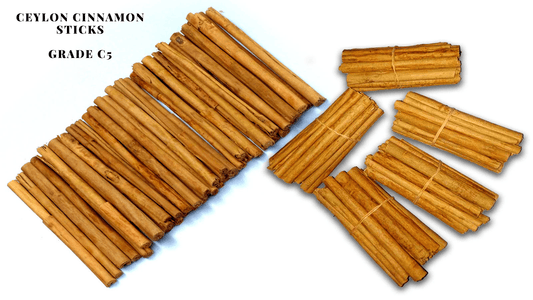
M5 is still genuine Ceylon cinnamon — that distinction from cassia matters — but it is at the lower end of the quality spectrum for retail-grade quills. The thicker quills include more of the outer bark layers, which contain more coumarin and contribute a woodier, less refined flavor profile compared to Alba or C5.
M5 has legitimate uses: slow-cooked dishes where cinnamon simmers for a long time, potpourri and decorative use, or as an entry-point product for consumers who are simply trying Ceylon cinnamon for the first time and want the lowest possible price. However, for anyone using cinnamon as a daily health supplement for blood sugar management or other therapeutic purposes, M5 is not the right choice — the higher coumarin content and lower alkaloid concentration relative to the premium grades undermine its health value.
Best Uses for M5 Grade
- Slow-cooked stews, biryanis, and tagines where bark is removed before serving
- Mulled wine and cider (removed before drinking)
- Decorative and aromatic use (potpourri, festive displays)
- First-time Ceylon cinnamon buyers testing the product category
- Commercial kitchen bulk use where cost is a primary constraint
6. Full Side-by-Side Comparison: Alba vs C5 vs M5
| Factor | Alba | C5 Special / C5 | M5 |
|---|---|---|---|
| Quill Diameter | Under 6mm | 6–10mm | 10–16mm |
| Coumarin Content | Lowest | Low | Moderate |
| Flavor Profile | Sweet, delicate, complex | Warm, aromatic, balanced | Strong, woody, pungent |
| Roll Quality | Extremely tight, multi-layer | Tight, well-formed | Thicker, less uniform |
| Color | Very pale tan | Light tan-brown | Darker brown |
| Daily Health Use | Ideal — lowest coumarin | Excellent | Not recommended |
| Fine Baking | Best — most delicate flavor | Very good | Acceptable |
| Everyday Cooking | Excellent (premium) | Best value | Acceptable |
| Gifting | Exceptional | Good | Not recommended |
| Price Point | Premium | Mid-premium | Budget |
| Who It's For | Health users, fine cooks, gift buyers | Everyday cooks, value seekers | Occasional use, first-timers |
7. Which Grade for Which Use Case?
| Your Goal | Recommended Grade | Why |
|---|---|---|
| Daily blood sugar or cholesterol support | Alba | Lowest coumarin; safest for daily supplementation |
| Making cinnamon tea every morning | Alba or C5 Special | Delicate flavor; low coumarin for frequent brewing |
| Premium baking — pastry, custards, fine desserts | Alba | Sweet, subtle flavor won't overpower delicate dishes |
| Everyday baking — cinnamon rolls, cookies, cakes | C5 | Excellent flavor-to-cost ratio for home baking |
| Grinding into cinnamon powder at home | C5 | Best balance of quality and economy when ground |
| Slow-cooked curries and stews (bark removed) | C5 or M5 | Stronger flavor holds up to long cooking; cost-effective |
| Gifting a premium spice | Alba | Presentation-quality quills; genuinely impressive product |
| First time buying Ceylon cinnamon | C5 | Best entry point — quality is excellent, price is accessible |
| Commercial kitchen / high-volume use | M5 | Budget grade where volume matters more than refinement |
| Children's food and infant recipes | Alba | Lowest coumarin content — most appropriate for young children |
8. Is Alba Worth the Extra Cost?
The honest answer is: yes, for the right buyer — and no, for some others. Here is how to think about it.
Alba is absolutely worth it if you:
- Use Ceylon cinnamon daily as part of a health routine (blood sugar, cholesterol, anti-inflammatory)
- Bake with it in applications where the cinnamon flavor is the star — not a background note
- Are buying it as a gift and want to give something genuinely premium
- Feed it to children regularly and want the lowest possible coumarin exposure
- Simply value having the finest quality version of what you use
C5 is the smarter buy if you:
- Use cinnamon frequently in cooked dishes where it's one of many flavors
- Want excellent authentic Ceylon cinnamon but are budget-conscious
- Use cinnamon 3–5 times per week rather than daily
- Are buying in bulk for a household that goes through cinnamon quickly
The coumarin difference is the most medically significant factor. While all Ceylon cinnamon grades are far safer than cassia — which contains coumarin at 50–100x the level found in Ceylon — among Ceylon grades themselves, Alba consistently tests lowest. For daily users, this is not a trivial distinction. According to the European Food Safety Authority's scientific opinion on coumarin (EFSA Journal, 2008), the tolerable daily intake (TDI) for coumarin is 0.1mg per kilogram of body weight. For a 70kg adult consuming cinnamon daily, grade selection genuinely matters.
Read more about how Ceylon cinnamon lowers blood sugar naturally and why quality grade matters for therapeutic use. Proper storage of Ceylon cinnamon sticks is also important regardless of which grade you choose — exposure to light, heat, and humidity degrades the active compounds in all grades.
Shop Ceylon Cinnamon Alba Grade
The finest grade of authentic Ceylon cinnamon — hand-rolled, sub-6mm quills, certified Sri Lankan origin.
View Alba Grade CinnamonFrequently Asked Questions
Final Verdict
The grading system exists for a reason — and the differences between grades are real, measurable, and meaningful. If you have been buying generic cinnamon or even unlabeled "Ceylon cinnamon" without knowing the grade, there is a good chance you have not yet experienced what Alba actually tastes and performs like. It is a genuinely different product.
Explore the full range of our Ceylon spice guides to continue building your knowledge, and browse our health benefits journal for the science behind Ceylon cinnamon's therapeutic applications.
Shop Premium Ceylon Cinnamon Alba Grade
Hand-rolled, sub-6mm quills. Certified Sri Lankan origin. The finest grade available.
Shop Alba Grade Now