Blue Lotus in Ancient Egypt: The Sacred Flower of the Pharaohs
Blue Lotus in Ancient Egypt: The Sacred Flower of the Pharaohs
No flower appears more frequently in ancient Egyptian art than the blue lotus. It is carved into temple columns at Karnak. It covers the walls of Tutankhamun's tomb. It is held by gods, offered to the dead, and depicted at every feast and ceremony across 3,000 years of Egyptian civilisation.
This was not decoration. The Egyptians understood something about this flower — its behaviour, its chemistry, its symbolic power — that made it inseparable from their understanding of creation, death, and the divine.
This guide covers what Egyptologists and archaeobotanists have actually documented: the historical evidence, the religious meanings, the ceremonial uses, and what modern science now tells us about why the Egyptians may have valued this flower so highly.
Nymphaea caerulea — the blue lotus — was among the most significant plants in ancient Egyptian culture, documented continuously from the Old Kingdom (c. 2700 BCE) through the Ptolemaic period (30 BCE). It held simultaneous roles as a religious symbol, funerary offering, medicinal plant, and ceremonial intoxicant. The species is confirmed through botanical analysis of archaeological plant remains recovered from multiple Egyptian sites including the tomb of Tutankhamun. Modern phytochemistry has since identified the active alkaloids — nuciferine and aporphine — that would have produced the mild psychoactive and anxiolytic effects associated with its ceremonial use.
- The Flower: What Is Nymphaea Caerulea?
- 3,000 Years of Blue Lotus: A Timeline
- The Creation Myth: Ra and the Primordial Lotus
- The Gods of the Lotus
- Blue Lotus in Egyptian Art and Architecture
- Ceremonial and Funerary Use
- Blue Lotus in Egyptian Medicine
- Was It Psychoactive? What Scholars Say
- Lotus Wine: The Evidence
- From the Nile to Now: The Continuous Thread
- Frequently Asked Questions
1. The Flower: What Is Nymphaea Caerulea?
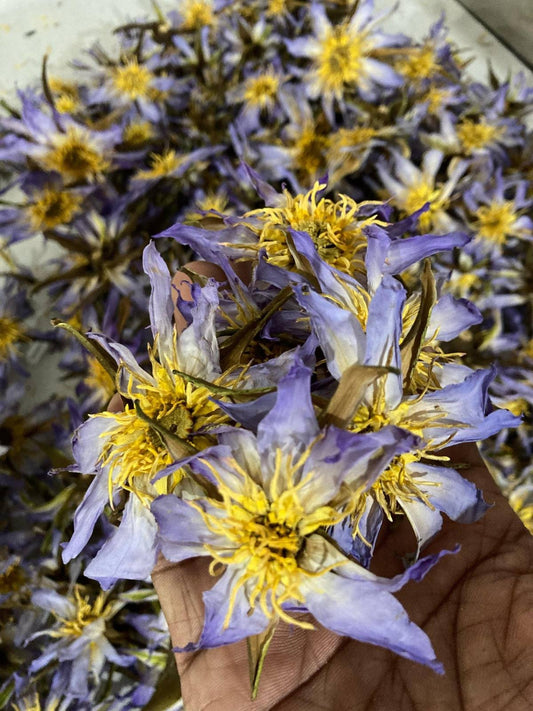
Nymphaea caerulea, the blue Egyptian lotus, is a water lily native to the Nile Valley and the lakes and wetlands of Sub-Saharan Africa. It should not be confused with two plants it is frequently mistaken for:
| Plant | Species | Origin | Role in Egypt |
|---|---|---|---|
| Blue Lotus | Nymphaea caerulea | Nile Valley, Sub-Saharan Africa | Primary sacred flower; ceremonial, medicinal, funerary |
| White Lotus | Nymphaea lotus | Nile Valley, East Africa | Secondary use; associated with Upper Egypt |
| Sacred Lotus | Nelumbo nucifera | South and East Asia | Introduced late (Ptolemaic period); not native to Egypt |
The distinction matters. The pink Nelumbo nucifera — the "lotus" most associated with Buddhism and Indian iconography — is a completely different plant that did not arrive in Egypt until the Ptolemaic period (332–30 BCE). When Egyptologists and historians discuss the Egyptian sacred lotus, they mean Nymphaea caerulea.
The blue lotus has a distinctive behaviour that made it remarkable to ancient observers: its flowers close at dusk and sink below the water surface, then rise and open again at dawn. In the Nile marshes, this daily cycle would have been impossible to miss — a flower that appeared to die and be reborn with the sun, every single day.
2. Three Thousand Years of Blue Lotus: A Timeline
-
c. 3100 BCE
Earliest dynastic period — blue lotus appears in proto-hieroglyphic symbols associated with Upper Egypt and kingship
-
c. 2700–2200 BCE
Old Kingdom — lotus columns appear in funerary architecture at Saqqara; flower established as royal and divine symbol
-
c. 2055–1650 BCE
Middle Kingdom — blue lotus integrated into coffin texts and funerary offering formulas; Nefertum cult established
-
c. 1550 BCE
Ebers Papyrus compiled — references lotus preparations for digestive, diuretic, and calming medicinal uses
-
c. 1550–1070 BCE
New Kingdom — peak depiction in tomb paintings; banquet scenes showing lotus-wine; Tutankhamun's tomb (c. 1323 BCE) contains garlands of dried blue lotus flowers
-
c. 1275 BCE
Papyrus of Ani (Book of the Dead) — blue lotus depicted in transformation spells; deceased shown emerging from lotus flower
-
c. 1350 BCE
Tomb of Nebamun, Thebes — now in the British Museum — includes one of the most celebrated depictions of blue lotus in a banquet scene
-
332–30 BCE
Ptolemaic period — blue lotus continues in Egyptian religious practice; Greco-Roman observers document its use; Nelumbo nucifera introduced from Asia
3. The Creation Myth: Ra and the Primordial Lotus
In Egyptian cosmology, before the world existed there was only Nun — the dark, infinite primordial ocean. From this chaos, a single blue lotus rose above the water. Its petals opened, and from within it emerged Ra, the sun god, as a child — the first light, the first being, the origin of all creation.
This myth is not peripheral. It is the central Egyptian account of how existence began. The blue lotus did not symbolise creation — it was creation. The daily opening and closing of the flower was understood as a re-enactment of this first moment, performed every day on the Nile.
The spell was intended to allow the deceased to transform into a blue lotus — to be reborn as Ra was reborn, to rise from darkness into light. The blue lotus was not a metaphor for resurrection. In Egyptian theological terms, it was the mechanism of it.
4. The Gods of the Lotus
Nefertum — God of the Lotus Blossom
Nefertum was the deity of the blue lotus itself — specifically the moment of its opening and the fragrance that rose from it. He was depicted as a beautiful young man wearing a blue lotus headdress, sometimes standing on a lotus, sometimes as a lion-headed figure (in his warrior aspect). His name means "the beautiful one" or "he who is beautiful and complete."
As a healer god, Nefertum was associated with the restorative power of the lotus fragrance. Texts describe Ra using the lotus scent to rejuvenate himself — and Nefertum as the embodiment of that rejuvenating power. Perfume and healing were linked in Egyptian medicine, and the lotus sat at the centre of both.
Ra — The Sun
Ra's emergence from the lotus at creation meant that every sunrise was understood as a re-enactment of that originary moment. Lotus offerings at dawn — particularly in solar temples — were acts of cosmological participation: helping the sun rise by re-performing the ritual conditions of its first rising.
Osiris — Death and Resurrection
Osiris, god of the underworld and of resurrection, was depicted surrounded by blue lotus flowers in funerary contexts. The logic was direct: as the lotus dies into the water each night and rises again at dawn, so Osiris died and was reborn, and so the deceased would follow. Lotus garlands were placed with the dead — archaeologically confirmed at multiple sites — as a physical enactment of this promise.
Horus
In some texts, the infant Horus — born to Isis after Osiris's death — is depicted emerging from a lotus flower, mirroring Ra's primordial birth. The lotus becomes the vessel of divine birth itself, used across multiple generational myths.
5. Blue Lotus in Egyptian Art and Architecture
The blue lotus is one of the most frequently occurring motifs across all of ancient Egyptian visual culture. Major examples include:
| Work / Site | Period | Lotus Depiction | Location Today |
|---|---|---|---|
| Tomb of Nebamun (Thebes) | c. 1350 BCE | Banquet scene — women wearing lotus garlands, lotus flowers in wine vessels | British Museum, London |
| Papyrus of Ani (Book of the Dead) | c. 1275 BCE | Deceased emerging from lotus; transformation spells | British Museum, London |
| Tomb of Tutankhamun | c. 1323 BCE | Golden shrine with lotus motifs; actual dried lotus garlands | Egyptian Museum, Cairo |
| Temple of Karnak | c. 1550–1070 BCE | Lotus-bud column capitals throughout hypostyle hall | Luxor, Egypt |
| Temple of Luxor | c. 1390–1352 BCE | Processional avenue; lotus in Amenhotep III's solar iconography | Luxor, Egypt |
| Golden Shrine of Tutankhamun | c. 1323 BCE | King depicted emerging from lotus flower — the pharaoh as Ra | Egyptian Museum, Cairo |
| Amarna tomb paintings | c. 1346–1332 BCE | Lotus in Atenist sun worship imagery | In situ, Amarna, Egypt |
The lotus column capital — a stylised blue lotus bud or open flower used as the top of a column — became one of the defining architectural elements of ancient Egyptian temples. Walking through the hypostyle hall at Karnak is walking through a stone forest of lotus flowers, each column a stem rising from the primordial waters of creation.
6. Ceremonial and Funerary Use
Banquets and Festivals
Tomb paintings from the New Kingdom consistently depict a specific ritual at feasts: guests hold blue lotus flowers to their faces, inhaling the scent. Servants carry large vessels containing wine with lotus flowers submerged in them. This is not background decoration — it recurs too consistently across too many tombs to be anything other than a documented practice.
The lotus-at-banquet scenes are interpreted by Egyptologists as serving two simultaneous functions: the religious (invoking Nefertum, participating in the solar renewal symbolism) and the pharmacological (the lotus flowers steeping in wine would extract the fat-soluble alkaloids, producing mild intoxication when consumed).
Funerary Offerings
Blue lotus flowers were among the most common funerary offerings placed in tombs. The garlands recovered from Tutankhamun's tomb — identified by botanist Percy Newberry in Howard Carter's 1922 excavation — included Nymphaea caerulea. Similar remains have been found at Deir el-Medina, the Valley of the Kings, and multiple sites at Saqqara.
Dried Nymphaea caerulea flowers were recovered from the tomb of Tutankhamun by botanist Percy Newberry during Howard Carter's 1922–1923 excavation. The flowers had been woven into garlands placed over the coffin — intact after over 3,300 years. This remains the most famous archaeobotanical confirmation of the blue lotus in an Egyptian burial context.
Temple Rituals
In solar temples, lotus flowers were offered at dawn as Ra rose — participating ritually in the re-enactment of creation. Temple pools were planted with blue lotus so that the flower's daily cycle could be observed and ritually acknowledged. The morning opening of the lotus corresponded to the morning opening of the temple sanctuary.
7. Blue Lotus in Egyptian Medicine
The Ebers Papyrus (c. 1550 BCE) is one of the oldest surviving medical texts in the world, containing over 700 remedies. Lotus preparations appear in several formulas:
- As a diuretic in kidney and urinary complaints
- For digestive disorders — "to open the bowels"
- Mixed into remedies for conditions we would today recognise as anxiety and sleeplessness
- In wound treatments and anti-inflammatory preparations
Egyptologist Lise Manniche, in her authoritative An Ancient Egyptian Herbal (1989), documented the lotus's medicinal roles extensively, noting that its use as a calming agent was consistent with both the textual record and the known pharmacology of the plant.
The Edwin Smith Papyrus, the world's oldest known surgical document, also references lotus in several contexts — suggesting it was part of practical medical treatment, not only ceremonial use.
8. Was It Psychoactive? What Scholars Say
This question has been debated in Egyptology and archaeobotany for decades. The current consensus has shifted significantly toward yes — with important qualifications about scale and context.
The key scholars and their positions:
| Scholar | Field | Position |
|---|---|---|
| Lise Manniche | Egyptology / Archaeobotany | Documented lotus in medicinal and ritual contexts; noted its calming properties were known and intentional |
| John Nunn | Ancient Egyptian Medicine | In Ancient Egyptian Medicine (1996), noted that lotus-wine combinations at banquets likely served a pharmacological function alongside the symbolic one |
| Dominique Görlitz & Stefan Brakmann | Archaeobotany | Argued for intentional use of psychoactive plants in Egyptian ritual contexts; positioned blue lotus as central |
| W.A. Emboden | Ethnobotany | Published influential 1978 paper identifying Nymphaea caerulea as a narcotic used in Egyptian ceremony; connected depictions to pharmacological use |
The modern phytochemical data supports the historical case. Nymphaea caerulea contains nuciferine (a D2 dopamine antagonist with anxiolytic and mild sedative effects) and aporphine (with euphoric properties). A study published in Fitoterapia confirmed nuciferine's anxiolytic activity in animal models. The alkaloids are fat-soluble, meaning steeping in wine — precisely as depicted in tomb paintings — extracts them more effectively than water.
The effect would not have been dramatic. Blue lotus is not a strong psychedelic. What the Egyptians likely experienced at banquets — a calm, slightly euphoric relaxation with mild perceptual sharpening — is exactly what modern users of quality blue lotus tea describe. In a ceremonial context, combined with music, movement, and ritual intent, that mild shift would have been meaningful.
9. Lotus Wine: The Evidence
The most concrete evidence for pharmacological use comes from the banquet tomb paintings, which consistently show a specific preparation: lotus flowers submerged in large wine vessels, with guests drinking from them. This is depicted at:
- The tomb of Nebamun (British Museum)
- The tomb of Nakht, Thebes (c. 1400 BCE)
- The tomb of Rekhmire, Thebes (c. 1450 BCE)
- Multiple tombs at Deir el-Medina
The steeping-in-wine preparation makes pharmacological sense. Nuciferine and aporphine are lipophilic (fat-soluble) — they extract poorly into plain water but much more effectively into an alcohol solution. Someone who designed this preparation empirically, over generations of use, would have arrived at wine steeping as the most effective method. The Egyptians did.
10. From the Nile to Now: The Continuous Thread
The blue lotus never entirely disappeared after the collapse of ancient Egyptian civilisation. Greek and Roman writers documented its use in Egypt. It was recorded by medieval Arab physicians. In East Africa, traditional use of Nymphaea species for calming and medicinal purposes has continued in various forms to the present day.
The modern revival is the most recent chapter in a very long story. The same species — authenticated Nymphaea caerulea — is now used globally as a tea, for relaxation, sleep, anxiety, and the enhancement of lucid dreaming.
What has changed is the scientific vocabulary we use to describe what the Egyptians observed empirically: nuciferine, D2 receptors, anxiolytic activity, REM modulation. What has not changed is the plant itself, or the basic human experience of its effects.
Read more about how blue lotus is used today:
- Blue Lotus Benefits, Effects, and How to Use It
- Blue Lotus for Anxiety: Does It Actually Calm You Down?
- Blue Lotus for Sleep: Does It Actually Work?
- Blue Lotus for Lucid Dreaming: What Reddit Says
The same species the Egyptians used. Whole dried Nymphaea caerulea flowers — organic, authenticated, traceable.
Shop Organic Blue Lotus Flowers →Frequently Asked Questions
Why was blue lotus sacred in ancient Egypt?
Blue lotus was sacred because it closes at night and reopens each morning, mirroring the daily journey of Ra, the sun god. This made it a symbol of creation, rebirth, and the cycle of life and death. It was also associated with Nefertum, god of the lotus, and with the primordial waters of creation in Egyptian cosmology.
Did ancient Egyptians use blue lotus to get high?
Modern phytochemistry confirms that Nymphaea caerulea contains nuciferine and aporphine alkaloids with mild psychoactive properties. Scholars including John Nunn and Lise Manniche have argued that Egyptians intentionally steeped lotus in wine at banquets to produce mild euphoric and calming effects. The effect would have been subtle — calm, grounded, mildly euphoric — not dramatic intoxication.
What god is associated with the blue lotus in Egypt?
The primary deity is Nefertum, god of the lotus blossom and of healing. Ra, the sun god, is also closely linked — texts describe him emerging from a blue lotus at the moment of creation. Osiris, god of the afterlife, was frequently depicted surrounded by lotus flowers in funerary contexts.
Where is blue lotus depicted in ancient Egyptian art?
Blue lotus appears in thousands of artworks across 3,000 years of Egyptian history. Major examples include the tomb of Tutankhamun, the Temple of Karnak's column capitals, the Papyrus of Ani, the tomb of Nebamun (British Museum), and the tomb of Nakht at Thebes.
Is the blue lotus in Egyptian art the same species sold today?
Yes. The species throughout ancient Egyptian art and confirmed in archaeological plant remains is Nymphaea caerulea — the same species used today. It is distinct from the white lotus (Nymphaea lotus) and entirely unrelated to the Asian sacred lotus (Nelumbo nucifera).
Was blue lotus used in Egyptian medicine?
Yes. The Ebers Papyrus (c. 1550 BCE) references lotus preparations for digestive complaints, as a diuretic, and for calming and sleep conditions. Egyptologist Lise Manniche documented these uses extensively in An Ancient Egyptian Herbal (1989).
How did ancient Egyptians prepare blue lotus?
Primarily by steeping the flowers in wine — depicted in tomb paintings showing lotus submerged in banquet wine vessels. They also used flowers as offerings, wore them as garlands, and brewed water infusions medicinally. The wine-steeping method extracts the fat-soluble alkaloids more effectively than water alone.
Did blue lotus actually grow in ancient Egypt?
Yes. Nymphaea caerulea grew abundantly in the Nile Delta, the marshes along the flood plain, and in temple sacred lakes. Archaeological plant remains have been recovered from the tomb of Tutankhamun, Amarna, Deir el-Medina, and multiple Theban tombs — confirming it was not imported but locally abundant.